

Male Facial Fat Grafting in Miami Beach, FL
Male facial fat grafting uses a patient’s own fat to restore or add volume to selected areas of the face. Fat is removed from a donor area with liposuction, prepared, and carefully transferred to areas that need additional contour or fullness. The procedure may be considered for age-related volume loss, naturally flat facial contours, asymmetry, or other concerns that affect facial balance. Dr. Miami Beach’s experienced team offers facial fat grafting in Miami Beach, Florida. We place particular emphasis on male facial and body aesthetics, including maintaining balance between facial structure and an athletic physique. For more information, please contact us or schedule an appointment online. We are conveniently located at 400 W. 41St Street, Suite #412, Miami Beach, FL 33140.
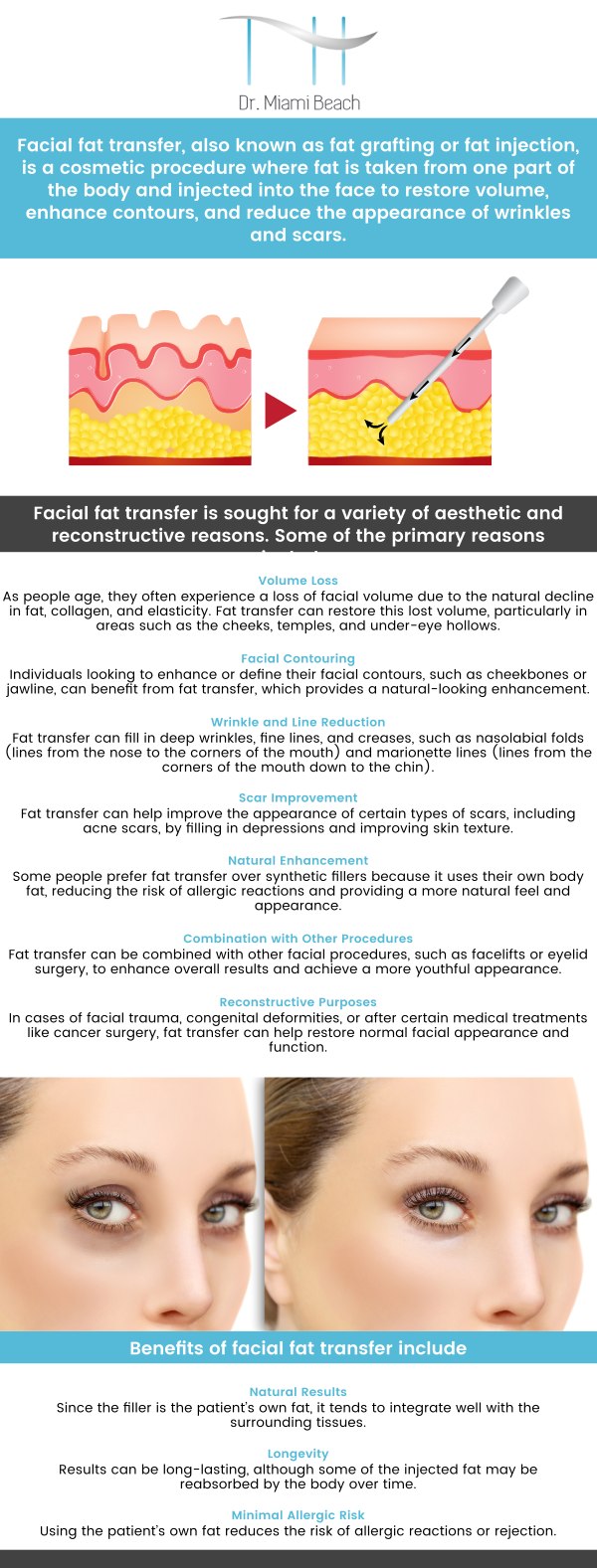
Table of Contents:
Who is a good candidate for male facial fat grafting?
What are the medical and physical prerequisites for undergoing a facial fat transfer for men?
What specific cosmetic goals, like jawline enhancement or restoring lost volume, can facial fat grafting accomplish for men?
Can facial fat grafting for men be used to treat medical conditions, injuries, or facial asymmetries?
Are there specific risks or side effects associated with transferring fat to the face?
What exactly happens during a male facial fat grafting surgical appointment?
Is facial fat grafting typically performed under local or general anesthesia?
What is the recovery timeline like for the face and the fat harvesting sites, such as the abdomen or love handles?
How long does it take to see the final, fully settled results of facial fat transfer?
Schedule a facial fat grafting consultation in Miami Beach, FL
A good candidate is generally a healthy man who wants to restore facial volume or improve certain contours using his own tissue rather than relying only on synthetic fillers or implants.
Candidates should typically be at a reasonably stable weight, have realistic expectations, and preferably not smoke. They also need enough suitable donor fat to harvest. The American Society of Plastic Surgeons notes that good candidates for facial augmentation procedures are generally physically healthy, at a stable weight, nonsmokers, and realistic about what surgery can accomplish.
Age alone does not determine candidacy. Younger men may consider fat grafting for naturally flat or uneven contours, while older patients may use it to restore volume that has decreased with aging or substantial weight loss.
Dr. Tarik Husain, MD, FACS evaluates the entire facial structure rather than simply adding volume to one area. Fat grafting may be appropriate on its own, or another treatment offered by the practice—such as a facelift, Spartan Neck jaw tightening, liposuction, or fillers—may better address concerns such as loose skin, excess fat, or structural imbalance.
Before surgery, a patient needs a medical evaluation to determine whether the procedure and anesthesia can be performed with an acceptable level of risk.
Preparation may include laboratory testing, review of current medications and supplements, and medical clearance when appropriate. Patients may also be instructed to stop smoking and avoid medications or supplements that can increase bleeding, but medication changes should only be made under medical guidance.
Weight stability also matters. Large weight changes after fat transfer may alter the appearance of the transferred fat and the donor area. ASPS guidance notes that significant weight loss during the period when grafted fat is becoming established may affect the result.
Other factors Dr. Tarik Husain may consider include:
• Overall health and ability to heal normally
• Previous facial surgery, fillers, or injuries
• Skin quality and facial anatomy
• The amount and location of available donor fat
• Current medications and health conditions
• Smoking or nicotine use
• The patient’s goals and expectations
Not every patient who wants additional facial volume is an appropriate candidate for surgery. A consultation is needed to determine whether fat grafting, another procedure, or no procedure is the safest choice.
Facial fat grafting is mainly a volume and contouring procedure. It may be used to restore fullness lost with aging or weight loss and to build up naturally shallow facial contours.
Fat can potentially be placed in areas such as the cheeks, temples, lips, or selected areas along the lower face. ASPS describes facial fat grafting as an option for increasing fullness, filling creases, building shallow contours, adding cheek volume, and sculpting selected areas of the jawline.
For male patients, treatment can be planned with masculine proportions in mind. For example, the goal may be to restore cheek support without creating excessive roundness or to improve the transition between the cheeks, jaw, and chin while preserving a stronger facial appearance.
Fat grafting does have limits. It does not build bone, tighten significantly loose skin, strengthen facial muscles, or remove unwanted fat beneath the chin. Men with significant skin laxity or neck fullness may need a different approach. Dr. Tarik Husain also offers male facelift and Spartan Neck procedures for patients whose concerns involve tissue laxity or jaw and neck definition rather than volume alone.
Yes. Autologous fat grafting is used in reconstructive as well as cosmetic plastic surgery. Research has evaluated its use for facial soft-tissue defects associated with trauma, previous surgery, burns, scars, congenital differences, facial atrophy, and other causes of volume loss or asymmetry.
A systematic review and meta-analysis of facial deformities found that fat transplantation can improve volume deficits and facial symmetry, although the amount of fat that survives and the degree of improvement vary by condition and patient.
However, the fact that facial fat grafting can be used reconstructively does not mean every medical condition or injury can be treated with it. Some asymmetries involve bone, nerves, muscles, scars, or active disease rather than a simple lack of soft-tissue volume.
Dr. Miami Beach specifically confirms facial fat grafting as a service, but the reviewed practice information does not establish that every reconstructive indication is treated at the clinic. Dr. Tarik Husain would need to evaluate the cause of an individual patient’s asymmetry before determining whether fat grafting is appropriate.
Yes. Temporary swelling, bruising, tenderness, and unevenness during healing can occur at both the facial treatment areas and the liposuction donor site.
Other possible complications include infection, bleeding, hematoma, prolonged swelling, asymmetry, contour irregularities, lumps, fatty cysts, fat necrosis, changes in sensation, poor healing, undercorrection or overcorrection, and the possible need for another procedure. Not all transferred fat survives, so the final volume cannot be predicted with complete precision.
Facial fat injection also carries rare but potentially severe vascular risks. If fat unintentionally enters a blood vessel, serious complications involving the eye, skin, or brain can occur. ASPS identifies blindness as a rare complication of facial fat transfer, and a 2024 systematic review of reported complications documented severe events including vision loss, neurological injury, and skin necrosis. The review emphasized the importance of detailed knowledge of facial anatomy and appropriate surgical technique.
These risks are one reason facial fat grafting should be treated as a surgical procedure rather than a simple cosmetic injection.
The procedure generally involves three main stages: harvesting, preparing, and transferring the fat.
First, a suitable donor area is selected. Fat may be removed through small liposuction incisions from an area such as the abdomen or another location with sufficient fatty tissue. The harvested fat is then processed before being placed into carefully selected areas of the face in small amounts.
The exact amount and placement depend on the patient’s facial anatomy and goals. Because some transferred fat will naturally be reabsorbed, surgeons must plan treatment with the expected changes during healing in mind.
Dr. Tarik Husain can also determine whether facial fat grafting should be performed alone or incorporated into another facial procedure when appropriate.
It can be performed using local anesthesia, intravenous sedation, or general anesthesia, depending on the extent of treatment, how much fat must be harvested, whether another surgery is being performed at the same time, and the individual patient’s health and comfort needs. ASPS guidance for facial fat-transfer-related cheek augmentation recognizes all three anesthesia approaches.
A smaller facial fat grafting procedure may require less anesthesia than a procedure performed together with a facelift or other surgery.
The reviewed Dr. Miami Beach materials do not specify one standard anesthesia method for every facial fat grafting patient, so the anesthesia plan should be confirmed during the surgical consultation.
Swelling and bruising are expected after facial fat grafting. Facial swelling may remain noticeable for approximately two weeks, although the exact duration differs among patients.
The donor area can also feel sore, swollen, or bruised after liposuction. Patients may need to limit strenuous activity while both areas heal. The amount of downtime depends on how much fat was harvested, which areas were treated, whether other procedures were performed, and the patient’s individual healing response.
Patients should follow Dr. Tarik Husain’s specific instructions regarding incision care, physical activity, sleeping position, medications, and follow-up appointments rather than relying on a fixed recovery schedule.
Some improvement is visible early, but the first appearance is affected by swelling and by fat that will not ultimately survive.
Transferred fat needs time to establish a blood supply. ASPS notes that roughly half of transferred facial fat may survive, although retention varies substantially among patients and techniques. Research has similarly shown that retention is variable rather than completely predictable.
The contour usually continues to change for several months. Published evidence suggests much of the change in graft volume occurs during the first few months and becomes more stable between approximately six months and one year.
Fat that successfully survives can provide long-lasting volume, but facial aging and future weight changes can still alter the result. Some patients may eventually choose an additional fat-transfer session or another facial procedure.
Men considering facial fat grafting can meet with Dr. Tarik Husain to discuss facial proportions, areas of volume loss, donor fat availability, previous treatments, and the changes they hope to achieve.
A personalized evaluation can determine whether male facial fat grafting is appropriate or whether another treatment offered at Dr. Miami Beach may better address the patient’s facial structure and goals. For more information, please contact us or schedule an appointment online. We are conveniently located at 400 W. 41St Street, Suite #412, Miami Beach, FL 33140. We serve clients from Miami Beach FL, Miami FL, Brickell FL, Bay Harbor Islands FL, Coral Gables FL, Sunny Isles FL, Key Biscayne FL, and surrounding areas.
Dr. Miami Beach — Facial Fat Grafting Specialist in Miami Beach, FL
View practice source
Dr. Miami Beach — Tarik Husain, MD, FACS
View provider profile
American Society of Plastic Surgeons — Fat Injections as Dermal Fillers
View ASPS guidance
American Society of Plastic Surgeons — Cheek Augmentation Candidates
View ASPS candidate guidance
American Society of Plastic Surgeons — Cheek Augmentation Preparation
View ASPS preparation guidance
American Society of Plastic Surgeons — Cheek Augmentation Risks and Safety
View ASPS safety guidance
PubMed — Complications Associated With Facial Autologous Fat Grafting for Aesthetic Purposes, 2024
View PubMed source
PubMed — Quantifying Outcomes of Autologous Fat Transplantation in Different Facial Deformities
View PubMed source
PubMed — Efficacy and Safety of Autologous Fat Transfer in Facial Reconstructive Surgery
View PubMed source
Check Out Our 5 Star Reviews


Additional Services You May Need

Additional Services You May Need
• Male Abs (Spartan Abs)
• BBL (Miami Butt Lift)
• Liposuction
• Mommy Makeover
• Jaw Tightening (Spartan Neck)
• Female Abs (Pilates Abs)™
• Facelift
• Wrinkle Relaxers
• Neurotoxins



 Send Text
 How May I Help You?


